
Revolutions to Degrees Converter
Enter the angle in revolutions below to convert it to degrees.
Result: Degrees
1 r = 360° 0′ 0″
Do you want to convert degrees to revolutions?
On this page:

Joe is the creator of Inch Calculator and has over 20 years of experience in engineering and construction. He holds several degrees and certifications.
How to Convert Revolutions to Degrees
To convert a measurement in revolutions to a measurement in degrees, multiply the angle by the following conversion ratio: 360 degrees/revolution.
Since one revolution is equal to 360 degrees, you can use this simple formula to convert:
degrees = revolutions × 360
The angle in degrees is equal to the angle in revolutions multiplied by 360.
For example, here's how to convert 5 revolutions to degrees using the formula above.
degrees = (5 r × 360) = 1,800°
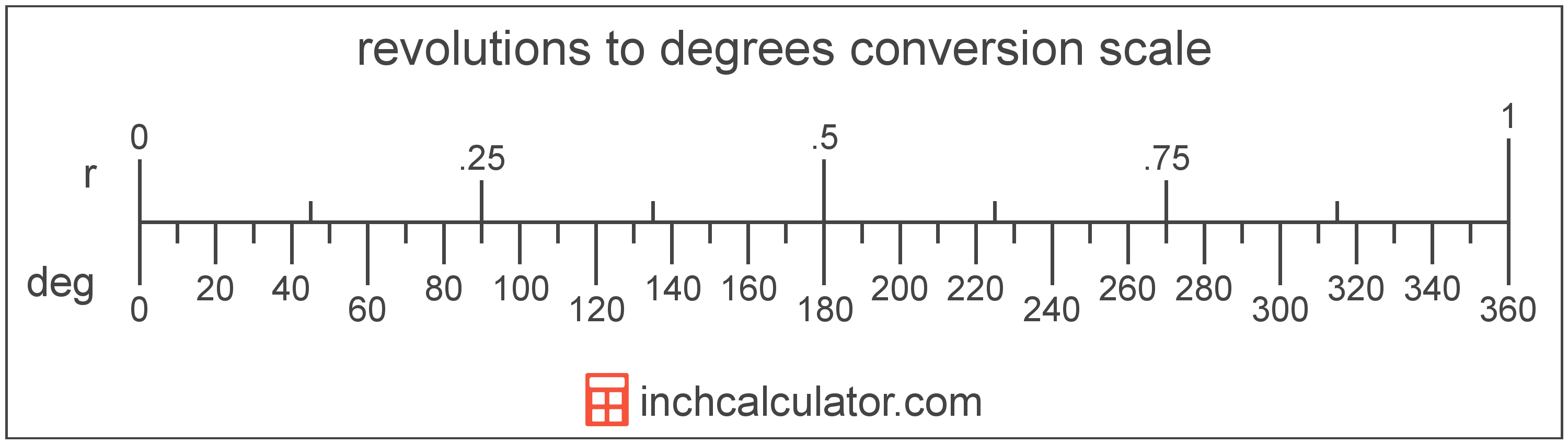
How Many Degrees Are in a Revolution?
There are 360 degrees in a revolution, which is why we use this value in the formula above.
1 r = 360°
Revolutions and degrees are both units used to measure angle. Keep reading to learn more about each unit of measure.
What Is a Revolution?
A revolution, or turn, is equal to 1 rotation around a circle, or 360°. Revolutions are commonly used to measure the speed of rotation, for example when measuring the revolutions per minute (RPM) of a vehicle's engine.
A revolution is sometimes also referred to as a turn, cycle, or complete rotation. Revolutions can be abbreviated as r, and are also sometimes abbreviated as rev or cyc. For example, 1 revolution can be written as 1 r, 1 rev, or 1 cyc.
Learn more about revolutions.
What Is a Degree?
A degree is a measure of angle equal to 1/360th of a revolution, or circle.[1] The number 360 has 24 divisors, making it a fairly easy number to work with. There are also 360 days in the Persian calendar year, and many theorize that early astronomers used 1 degree per day.
The degree is an SI accepted unit for angle for use with the metric system. A degree is sometimes also referred to as a degree of arc, arc degree, or arcdegree. Degrees can be abbreviated as °, and are also sometimes abbreviated as deg. For example, 1 degree can be written as 1° or 1 deg.
Degrees can also be expressed using arcminutes and arcseconds as an alternative to using the decimal form. Arcminutes and arcseconds are expressed using the prime (′) and double-prime (″) characters, respectively, although a single-quote and double-quote are often used for convenience.
One arcminute is equal to 1/60th of a degree, and one arcsecond is equal to 1/60th of an arcminute.
Protractors are commonly used to measure angles in degrees. They are semi-circle or full-circle devices with degree markings allowing a user to measure an angle in degrees. Learn more about how to use a protractor or download a printable protractor.
Learn more about degrees.
Revolution to Degree Conversion Table
| Revolutions | Degrees |
|---|---|
| 1 r | 360° |
| 2 r | 720° |
| 3 r | 1,080° |
| 4 r | 1,440° |
| 5 r | 1,800° |
| 6 r | 2,160° |
| 7 r | 2,520° |
| 8 r | 2,880° |
| 9 r | 3,240° |
| 10 r | 3,600° |
| 11 r | 3,960° |
| 12 r | 4,320° |
| 13 r | 4,680° |
| 14 r | 5,040° |
| 15 r | 5,400° |
| 16 r | 5,760° |
| 17 r | 6,120° |
| 18 r | 6,480° |
| 19 r | 6,840° |
| 20 r | 7,200° |
| 21 r | 7,560° |
| 22 r | 7,920° |
| 23 r | 8,280° |
| 24 r | 8,640° |
| 25 r | 9,000° |
| 26 r | 9,360° |
| 27 r | 9,720° |
| 28 r | 10,080° |
| 29 r | 10,440° |
| 30 r | 10,800° |
| 31 r | 11,160° |
| 32 r | 11,520° |
| 33 r | 11,880° |
| 34 r | 12,240° |
| 35 r | 12,600° |
| 36 r | 12,960° |
| 37 r | 13,320° |
| 38 r | 13,680° |
| 39 r | 14,040° |
| 40 r | 14,400° |
References
- Collins Dictionary, Definition of 'degree', https://www.collinsdictionary.com/us/dictionary/english/degree