
Sales Tax Calculator
Calculate a price before or after sales tax is applied using the sales tax calculator below.
Results: Price With Sales Tax
Total Sales Tax
Total Sales Tax
On this page:

Joe is the creator of Inch Calculator and has over 20 years of experience in engineering and construction. He holds several degrees and certifications.
How to Calculate a Price With Sales Tax
Sales tax is a percentage of the purchase price that is added to the cost of goods and services. The amount of sales tax you pay depends on the applicable tax rate, which can vary depending on the state, county, and city where a purchase is made.
Calculating the price after sales tax is relatively simple if you know the sales tax rate. You can calculate the amount of tax added to a purchase and then add it to the original price to determine the total cost.
Sales Tax Price Formula
To calculate the price after sales tax, multiply the original price by 1 plus the sales tax rate expressed as a decimal. So, if the sales tax rate is 5%, multiply the price by 1 + 0.05, or 1.05.
The formula for calculating the price after sales tax is:
total price = price before tax × (1 + tax rate)
Thus, the total price after tax is equal to the price before tax multiplied by 1 + the tax rate. Note that the tax rate must be in decimal form, so divide the rate by 100% to use in this formula.
Once you have the total cost, you can use our unit price calculator to calculate the cost of each item after sales tax.
For example, let’s calculate the price after sales tax for an item that costs $100 given a sales tax rate of 7%.
First, convert the sales tax percentage to a decimal by dividing it by 100:
rate as a decimal = 7% ÷ 100 = 0.07
Then, add 1 to the rate:
total rate = 1 + 0.07 = 1.07
Finally, multiply the price by the total sales tax rate:
total price = $100 × 1.07 = $107
Therefore, the total price after sales tax is $107.
Sales Tax Rates by State
Sales tax rates vary considerably across the United States. Unlike many countries, which have a national value-added tax (VAT), the United States primarily relies on state and local governments to collect sales tax.
Most states impose a statewide sales tax, but some also allow counties, cities, and other local jurisdictions to impose their own taxes in addition. As a result, the actual sales tax rate can vary significantly depending on where you make a purchase.
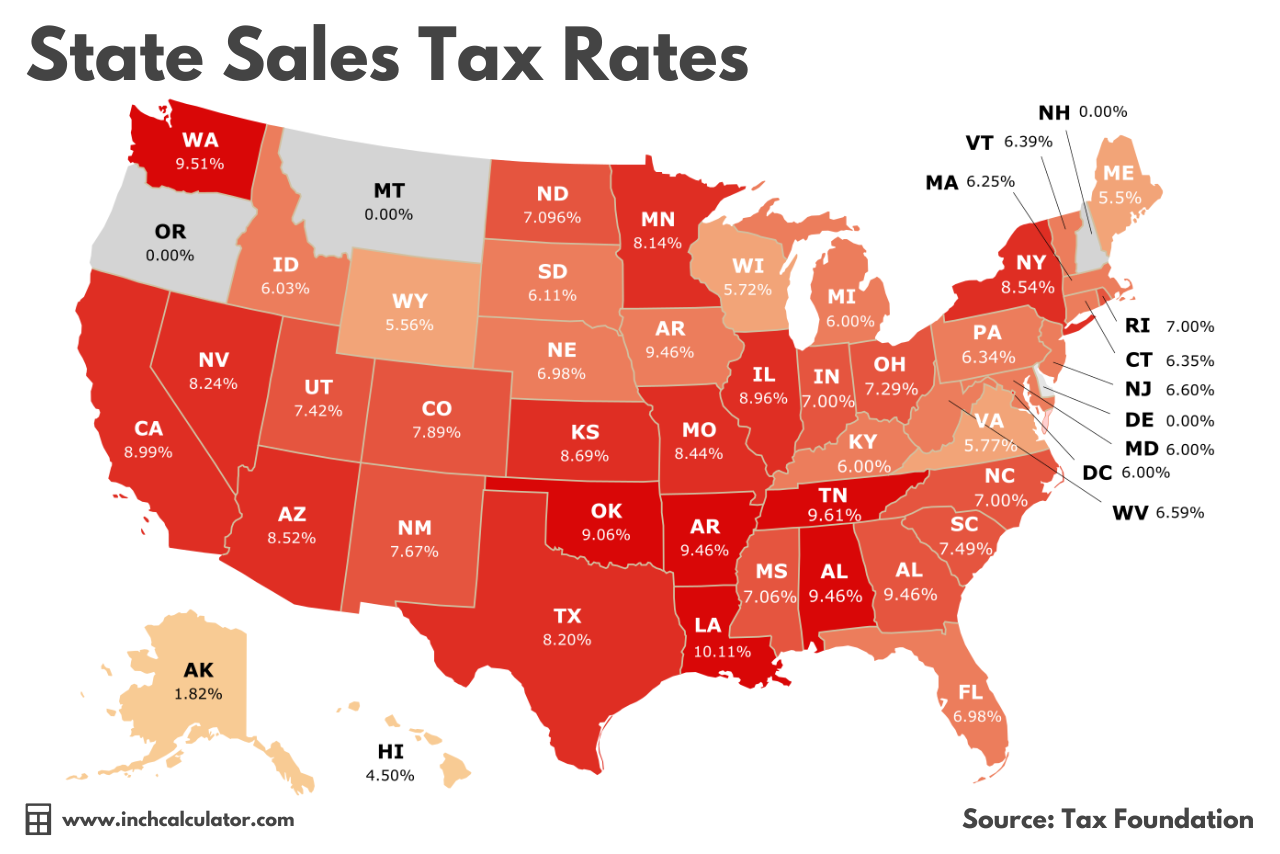
The following chart shows the statewide sales tax rates and average combined state and local sales tax rates for each state as of 2026.[1]
| State | State Sales Tax | Local Sales Tax (Avg) | Combined Local & State Sales Tax (Avg) |
|---|---|---|---|
| Alabama | 4.00% | 5.46% | 9.46% |
| Alaska | 0.00% | 1.82% | 1.82% |
| Arizona | 5.60% | 2.92% | 8.52% |
| Arkansas | 6.50% | 2.96% | 9.46% |
| California | 7.25% | 1.74% | 8.99% |
| Colorado | 2.90% | 4.99% | 7.89% |
| Connecticut | 6.35% | 0.00% | 6.35% |
| Delaware | 0.00% | 0.00% | 0.00% |
| Florida | 6.00% | 0.98% | 6.98% |
| Georgia | 4.00% | 3.49% | 7.49% |
| Hawaii | 4.00% | 0.50% | 4.50% |
| Idaho | 6.00% | 0.03% | 6.03% |
| Illinois | 6.25% | 2.71% | 8.96% |
| Indiana | 7.00% | 0.00% | 7.00% |
| Iowa | 6.00% | 0.94% | 6.94% |
| Kansas | 6.50% | 2.19% | 8.69% |
| Kentucky | 6.00% | 0.00% | 6.00% |
| Louisiana | 5.00% | 5.11% | 10.11% |
| Maine | 5.50% | 0.00% | 5.50% |
| Maryland | 6.00% | 0.00% | 6.00% |
| Massachusetts | 6.25% | 0.00% | 6.25% |
| Michigan | 6.00% | 0.00% | 6.00% |
| Minnesota | 6.88% | 1.26% | 8.14% |
| Mississippi | 7.00% | 0.06% | 7.06% |
| Missouri | 4.23% | 4.22% | 8.44% |
| Montana | 0.00% | 0.00% | 0.00% |
| Nebraska | 5.50% | 1.48% | 6.98% |
| Nevada | 6.85% | 1.39% | 8.24% |
| New Hampshire | 0.00% | 0.00% | 0.00% |
| New Jersey | 6.63% | -0.02% | 6.60% |
| New Mexico | 4.88% | 2.79% | 7.67% |
| New York | 4.00% | 4.54% | 8.54% |
| North Carolina | 4.75% | 2.25% | 7.00% |
| North Dakota | 5.00% | 2.09% | 7.09% |
| Ohio | 5.75% | 1.54% | 7.29% |
| Oklahoma | 4.50% | 4.56% | 9.06% |
| Oregon | 0.00% | 0.00% | 0.00% |
| Pennsylvania | 6.00% | 0.34% | 6.34% |
| Rhode Island | 7.00% | 0.00% | 7.00% |
| South Carolina | 6.00% | 1.49% | 7.49% |
| South Dakota | 4.20% | 1.91% | 6.11% |
| Tennessee | 7.00% | 2.61% | 9.61% |
| Texas | 6.25% | 1.95% | 8.20% |
| Utah | 6.10% | 1.32% | 7.42% |
| Vermont | 6.00% | 0.39% | 6.39% |
| Virginia | 5.30% | 0.47% | 5.77% |
| Washington | 6.50% | 3.01% | 9.51% |
| West Virginia | 6.00% | 0.59% | 6.59% |
| Wisconsin | 5.00% | 0.72% | 5.72% |
| Wyoming | 4.00% | 1.56% | 5.56% |
| District of Columbia | 6.00% | 0.00% | 6.00% |
California has the highest statewide sales tax rate at 7.25%, while Colorado has the lowest nonzero statewide rate at 2.90%.
Five states have no statewide sales tax: Alaska, Delaware, Montana, New Hampshire, and Oregon. However, Alaska allows local governments to impose sales taxes.
Louisiana has the highest average combined state and local rate at 10.13%, while Alaska has the lowest average combined rate among states that impose sales taxes at 1.82%.
Keep in mind that these are average rates. The actual rate charged on a purchase depends on its specific tax jurisdiction and the type of product or service being purchased. Some items, such as groceries and clothing, may also be exempt or taxed at different rates depending on the state.
Sales Tax vs. Value-Added Tax (VAT)
Sales tax and value-added tax (VAT) are both consumption taxes imposed by governments; however, they differ in how and when the tax is collected.
Sales tax is generally collected one time, at the final point of sale when a customer purchases an item from a retailer. The retailer collects the applicable sales tax and adds it to the purchase price.
For example, if a retailer sells an item for $100 and the sales tax rate is 8%, the customer pays $108. The retailer collects the $8 in sales tax and submits it to the relevant tax authority.
Value-added tax (VAT), on the other hand, is collected at multiple stages of production and distribution. Businesses charge VAT on their sales but can generally claim credits for VAT paid on eligible business purchases. Each business remits the difference between the VAT collected and the VAT paid on its purchases.
VAT is commonly used throughout Europe and many other parts of the world. The United States does not have a national VAT system and instead relies primarily on state and local sales taxes.
Ultimately, in both cases, the final consumer bears the tax. The good news is that you can use our discount calculator to see how much you can save when an item goes on sale.
Similar Personal Finance Calculators
References
- Mandal, A., State and Local Sales Tax Rates, 2026, January 20, 2026, https://taxfoundation.org/data/all/state/sales-tax-rates/