
Kinetic Energy Calculator
Use our kinetic energy calculator to find the kinetic energy, velocity, or mass.
Results: Kinetic Energy
Kinetic Energy Formula:
Mass Formula:
Velocity Formula:
On this page:

Joe is the creator of Inch Calculator and has over 20 years of experience in engineering and construction. He holds several degrees and certifications.
What Is Kinetic Energy?
Kinetic energy is the energy an object has because it is moving. If something is in motion, it has kinetic energy.
The amount of kinetic energy depends on how heavy the object is and how fast it’s moving. For instance, a speeding car has more kinetic energy than a rolling soccer ball because it’s much heavier and moving faster.
Kinetic energy is different from potential energy since it’s the energy of an object in motion. Potential energy, on the other hand, is the stored energy of an object based on its position.[1]
Note that objects that are not in motion have no kinetic energy. So, a parked car has no kinetic energy at all.
How to Calculate Kinetic Energy
Since the amount of kinetic energy an object has depends on its mass and velocity, you need to calculate those things first. You can use our mass calculator and our velocity calculator to find those properties.
Once you have the mass and velocity, you can use a simple formula to calculate kinetic energy.
Kinetic Energy Formula
The formula to calculate the kinetic energy of an object, body, or particle is:
Thus, the kinetic energy KE in Joules is equal to 1/2 times the object’s mass m in kilograms times its velocity v in meters per second squared.[2]
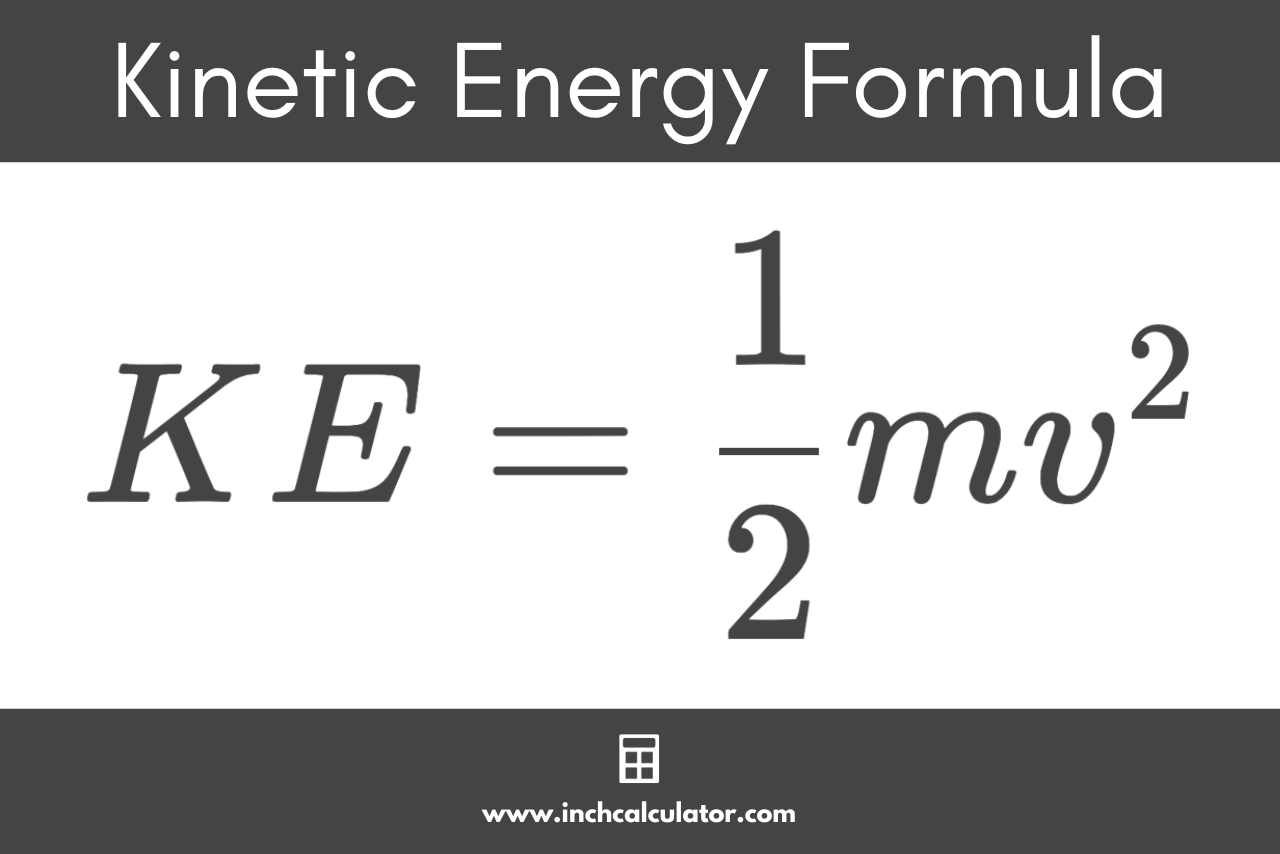
For example, we can use the formula above to calculate the kinetic energy of an object with a mass of 12 kilograms that is moving at a velocity of 7 meters per second.
So, using the formula, we can calculate that this object has the kinetic energy of 294 Joules. You can use our energy converter in other units, such as watt-hours.
References
- NASA, Energy Activity, https://www.grc.nasa.gov/www/k-12/BGA/Mike/energy_act.htm
- LibreTexts, University Physics I - Mechanics, Sound, Oscillations, and Waves, https://phys.libretexts.org/Bookshelves/University_Physics/University_Physics_(OpenStax)/Book%3A_University_Physics_I_-_Mechanics_Sound_Oscillations_and_Waves_(OpenStax)/07%3A_Work_and_Kinetic_Energy/7.03%3A_Kinetic_Energy