
Gravitational Potential Energy Calculator
Use our gravitational potential energy calculator to find the potential energy, mass, or height.
Results: Potential Energy
Potential Energy Formula:
Mass Formula:
Gravitational Acceleration Formula:
Height Formula:
On this page:

Joe is the creator of Inch Calculator and has over 20 years of experience in engineering and construction. He holds several degrees and certifications.
What Is Gravitational Potential Energy?
Gravitational potential energy is the stored energy an object has because of its position in a gravitational field, usually because it is above the ground.[1]
The higher an object is, and the heavier it is, the more gravitational potential energy it has.
For instance, a book on a high shelf has gravitational potential energy because gravity could pull it down. If it falls, that stored energy turns into kinetic energy as it moves.
How to Calculate Gravitational Potential Energy
To calculate the potential energy of an object, you need to know its mass, the acceleration due to gravitational force, and its height. Once you have these values, you can use a formula to calculate.
Gravitational Potential Energy Formula
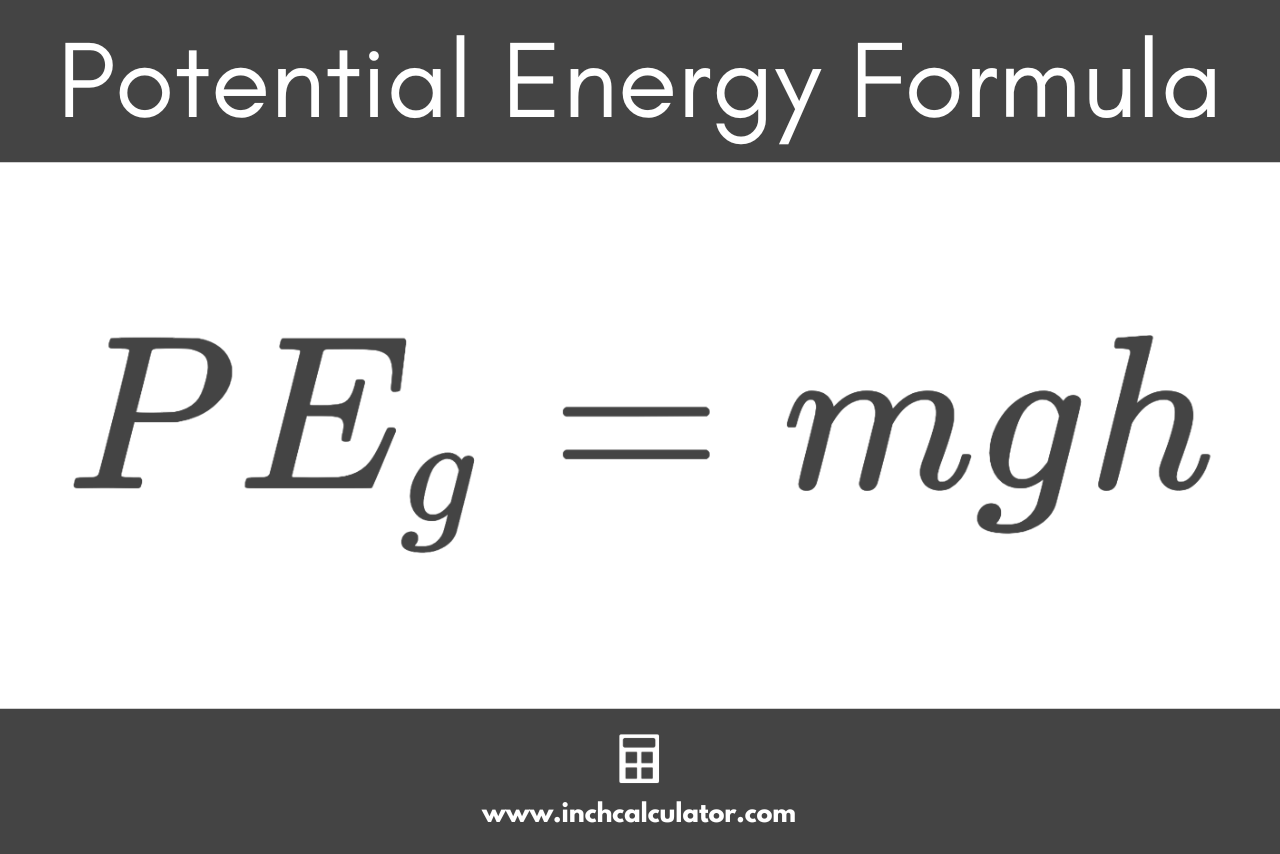
The gravitational potential energy formula states:
Thus, the potential energy PEg of an object in Joules is equal to its mass m in kilograms times the acceleration due to gravity g in meters per second times its height h in meters.[2]
On Earth, the acceleration due to gravity is equal to 9.80665 meters per second squared, or 1 g.
For example, let’s calculate the potential energy of a bowling ball weighing 5 kilograms that is sitting on a shelf 2 meters off the ground. Recall that the acceleration due to gravity is equal to 9.80665 meters per second squared.
Using the formula, you can see that the bowling ball has the potential energy of 98.0665 Joules. You can find the energy in a different unit using our energy converter.
References
- U.S. Energy Information Administration, What is energy?, https://www.eia.gov/energyexplained/what-is-energy/forms-of-energy.php
- NASA, Energy Activity, https://www.grc.nasa.gov/www/k-12/BGA/Mike/energy_act.htm