
Gear Ratio Calculator
Use the calculator below to calculate a gear ratio. You can also calculate the speed and torque at the output gear.
Results: Calculated Gear Ratio
Output Speed
Output Torque
On this page:

Joe is the creator of Inch Calculator and has over 20 years of experience in engineering and construction. He holds several degrees and certifications.
How to Calculate a Gear Ratio
A gear ratio is a measure of the relationship between two meshing gears. It describes how many times the driving gear must rotate to turn the driven gear one complete revolution.
Gear ratios are used in automobiles, bicycles, machinery, gearboxes, and many other mechanical systems to change speed, torque, and rotational direction.
A gear ratio can be calculated by comparing the number of teeth on the driving gear to the number of teeth on the driven gear. Knowing the gear ratio helps engineers and mechanics determine how a system will perform and whether it will increase speed or torque.
Gear Ratio Formula
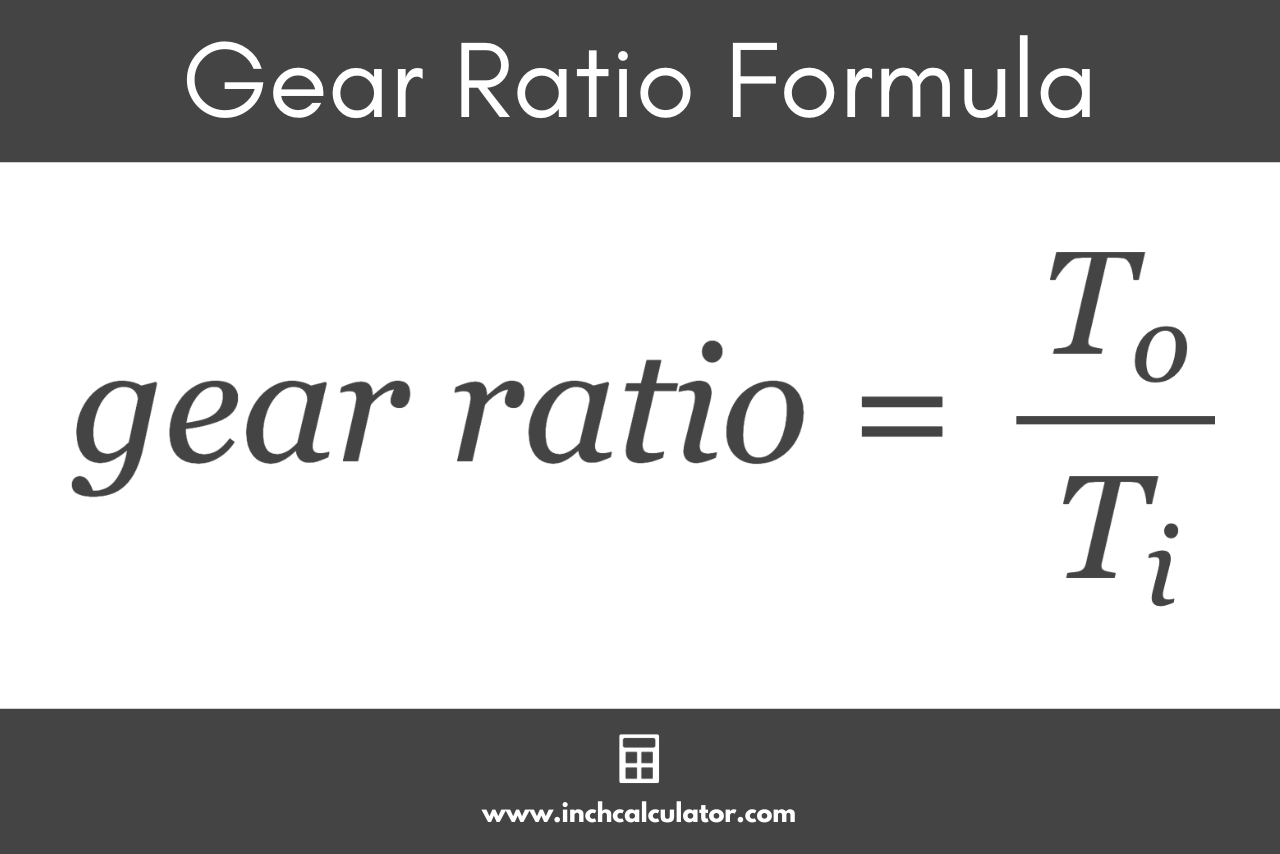
You can calculate the gear ratio using the following formula:
gear ratio = To / Ti
So, the gear ratio is equal to the number of teeth on driven gear To divided by the number of teeth on driving gear Ti.
How to Calculate Output Speed
Gear ratios affect rotational speed. When a smaller gear drives a larger gear, the output speed decreases. When a larger gear drives a smaller gear, the output speed increases.
You can calculate the output speed using the formula:
output RPM = input RPM / gear ratio
The rotational speed of the output gear in RPM is equal to the rotational speed of the input gear divided by the gear ratio.
How to Calculate Output Torque
One of the primary purposes of a gear reduction is to increase torque. Ignoring friction and mechanical losses, output torque increases in proportion to the gear ratio.
You can calculate the output torque using the formula:
output torque = input torque × gear ratio
The output torque is equal to the input torque times the gear ratio.