
Hertz to Radians per Second Converter
Enter the frequency in hertz below to convert it to radians per second.
Result: Radians per Second
Do you want to convert radians per second to hertz?
On this page:

Joe is the creator of Inch Calculator and has over 20 years of experience in engineering and construction. He holds several degrees and certifications.
How to Convert Hertz to Radians per Second
To convert a measurement in hertz to a measurement in radians per second, multiply the frequency by the following conversion ratio: 6.283185 radians per second/hertz.
Since one hertz is equal to 6.283185 radians per second, you can use this simple formula to convert:
radians per second = hertz × 6.283185
The frequency in radians per second is equal to the frequency in hertz multiplied by 6.283185.
For example, here's how to convert 5 hertz to radians per second using the formula above.
radians per second = (5 Hz × 6.283185) = 31.415927 rad/s
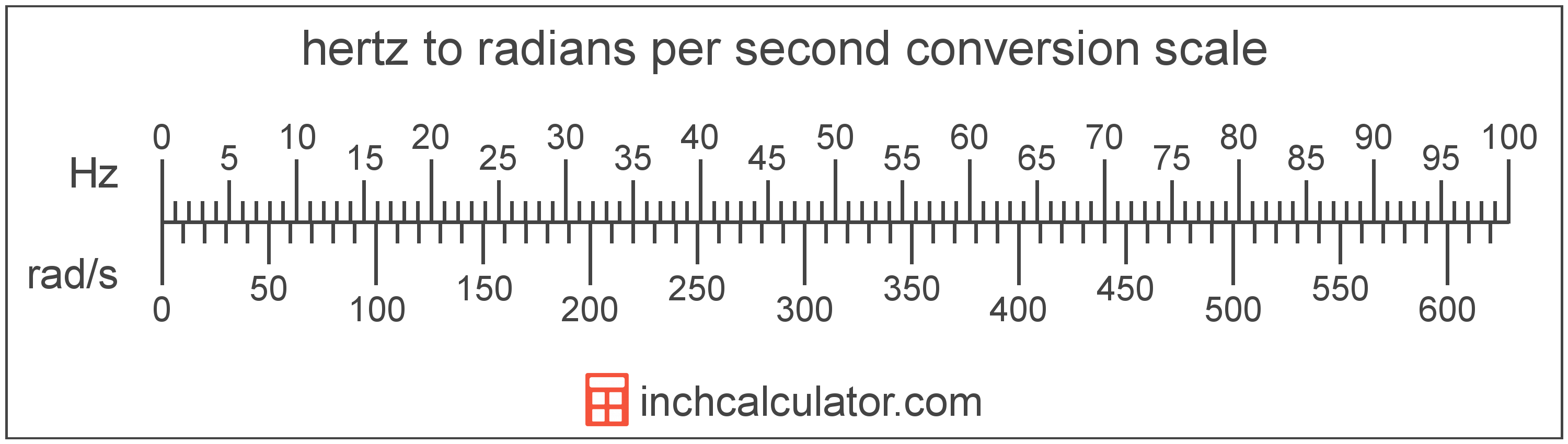
How Many Radians per Second Are in a Hertz?
There are 6.283185 radians per second in a hertz, which is why we use this value in the formula above.
1 Hz = 6.283185 rad/s
The following formula can also be used to convert the angular frequency in radians per second to frequency in hertz:
ω = 2πƒ
In other words, the angular frequency ω in radians per second is equal to 2 times pi times the frequency ƒ in hertz.
Hertz and radians per second are both units used to measure frequency. Keep reading to learn more about each unit of measure.
What Is a Hertz?
One hertz is formally defined as the frequency of one cycle per second.[1]
The hertz is the SI derived unit for frequency in the metric system. Hertz can be abbreviated as Hz; for example, 1 hertz can be written as 1 Hz.
Frequency in hertz can be expressed using the formula:
Hz = Cycles / Time in Seconds
Learn more about hertz.
What Are Radians per Second?
Radians per second are a measure of angular frequency, or rotational speed, equal to the change in the angular orientation of an object over one second.
Radians per second can be abbreviated as rad/s; for example, 1 radian per second can be written as 1 rad/s.
In the expressions of units, the slash, or solidus (/), is used to express a change in one or more units relative to a change in one or more other units.[2] For example, rad/s is expressing a change in angle relative to a change in time.
Learn more about radians per second.
Hertz to Radian per Second Conversion Table
| Hertz | Radians Per Second |
|---|---|
| 1 Hz | 6.2832 rad/s |
| 2 Hz | 12.57 rad/s |
| 3 Hz | 18.85 rad/s |
| 4 Hz | 25.13 rad/s |
| 5 Hz | 31.42 rad/s |
| 6 Hz | 37.7 rad/s |
| 7 Hz | 43.98 rad/s |
| 8 Hz | 50.27 rad/s |
| 9 Hz | 56.55 rad/s |
| 10 Hz | 62.83 rad/s |
| 11 Hz | 69.12 rad/s |
| 12 Hz | 75.4 rad/s |
| 13 Hz | 81.68 rad/s |
| 14 Hz | 87.96 rad/s |
| 15 Hz | 94.25 rad/s |
| 16 Hz | 100.53 rad/s |
| 17 Hz | 106.81 rad/s |
| 18 Hz | 113.1 rad/s |
| 19 Hz | 119.38 rad/s |
| 20 Hz | 125.66 rad/s |
| 21 Hz | 131.95 rad/s |
| 22 Hz | 138.23 rad/s |
| 23 Hz | 144.51 rad/s |
| 24 Hz | 150.8 rad/s |
| 25 Hz | 157.08 rad/s |
| 26 Hz | 163.36 rad/s |
| 27 Hz | 169.65 rad/s |
| 28 Hz | 175.93 rad/s |
| 29 Hz | 182.21 rad/s |
| 30 Hz | 188.5 rad/s |
| 31 Hz | 194.78 rad/s |
| 32 Hz | 201.06 rad/s |
| 33 Hz | 207.35 rad/s |
| 34 Hz | 213.63 rad/s |
| 35 Hz | 219.91 rad/s |
| 36 Hz | 226.19 rad/s |
| 37 Hz | 232.48 rad/s |
| 38 Hz | 238.76 rad/s |
| 39 Hz | 245.04 rad/s |
| 40 Hz | 251.33 rad/s |
References
- National Institute of Standards and Technology, SI Units - Time, https://www.nist.gov/pml/owm/si-units-time
- National Institute of Standards and Technology, NIST Guide to the SI, Chapter 6: Rules and Style Conventions for Printing and Using Units, https://www.nist.gov/pml/special-publication-811/nist-guide-si-chapter-6-rules-and-style-conventions-printing-and-using