
Kilohenries to Henries Converter
Enter the electrical inductance in kilohenries below to convert it to henries.
Result: Henries
Do you want to convert henries to kilohenries?
On this page:

Joe is the creator of Inch Calculator and has over 20 years of experience in engineering and construction. He holds several degrees and certifications.
How to Convert Kilohenries to Henries
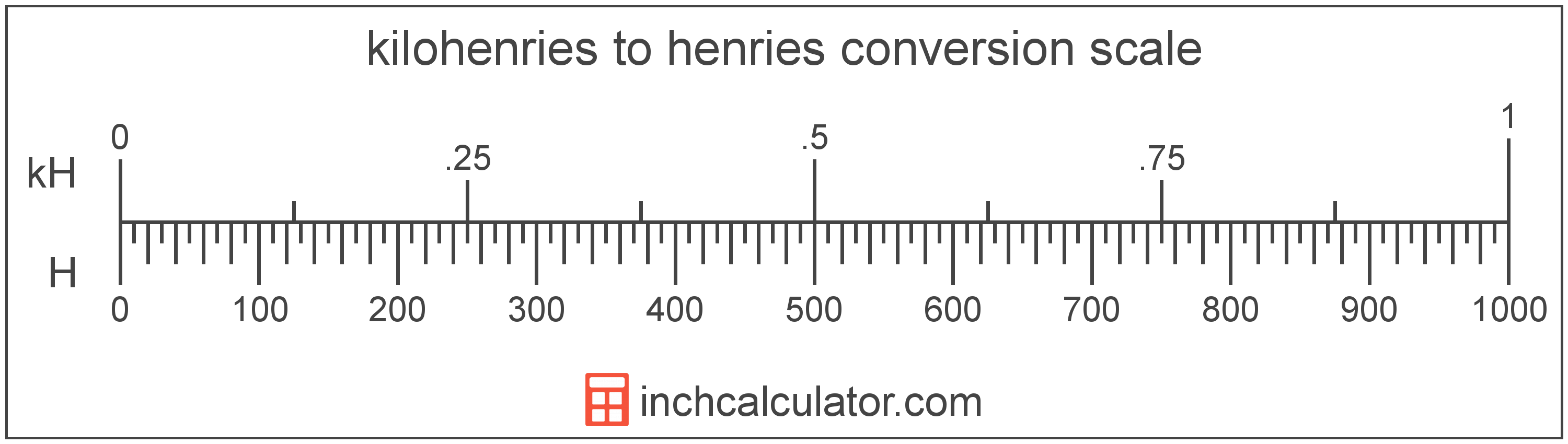
To convert kilohenries to henries, multiply the electrical inductance by the following conversion ratio: 1,000 henries/kilohenry.
Since one kilohenry is equal to 1,000 henries, you can use this simple formula to convert:
henries = kilohenries × 1,000
The electrical inductance in henries is equal to the electrical inductance in kilohenries multiplied by 1,000.
For example, here's how to convert 5 kilohenries to henries using the formula above.
henries = (5 kH × 1,000) = 5,000 H
How Many Henries Are in a Kilohenry?
There are 1,000 henries in a kilohenry, which is why we use this value in the formula above.
1 kH = 1,000 H
Kilohenries and henries are both units used to measure electrical inductance. Keep reading to learn more about each unit.
What Is a Kilohenry?
One kilohenry is equal to 1,000 henries, which are the inductance of a conductor with one volt of electromotive force when the current is increased by one ampere per second.
The kilohenry is a multiple of the henry, the SI derived unit for electrical inductance. In the metric system, "kilo" is the prefix for thousands, or 103. Kilohenries can be abbreviated as kH; for example, 1 kilohenry can be written as 1 kH.
Learn more about kilohenries.
What Is a Henry?
One henry is equal to the inductance of a conductor in which there is one volt of electromotive force when the current through the conductor is increased by one ampere per second.[1]
The henry is the SI derived unit for electrical inductance in the metric system. Henries can be abbreviated as H; for example, 1 henry can be written as 1 H.
The National Institute of Standards and Technology recommends using "henries" as the plural form of the unit, however the usage of "henrys" is also common.[2]
Learn more about henries.
Kilohenry to Henry Conversion Table
| Kilohenries | Henries |
|---|---|
| 0.001 kH | 1 H |
| 0.002 kH | 2 H |
| 0.003 kH | 3 H |
| 0.004 kH | 4 H |
| 0.005 kH | 5 H |
| 0.006 kH | 6 H |
| 0.007 kH | 7 H |
| 0.008 kH | 8 H |
| 0.009 kH | 9 H |
| 0.01 kH | 10 H |
| 0.02 kH | 20 H |
| 0.03 kH | 30 H |
| 0.04 kH | 40 H |
| 0.05 kH | 50 H |
| 0.06 kH | 60 H |
| 0.07 kH | 70 H |
| 0.08 kH | 80 H |
| 0.09 kH | 90 H |
| 0.1 kH | 100 H |
| 0.2 kH | 200 H |
| 0.3 kH | 300 H |
| 0.4 kH | 400 H |
| 0.5 kH | 500 H |
| 0.6 kH | 600 H |
| 0.7 kH | 700 H |
| 0.8 kH | 800 H |
| 0.9 kH | 900 H |
| 1 kH | 1,000 H |
References
- International Bureau of Weights and Measures, The International System of Units, 9th Edition, 2019, https://www.bipm.org/documents/20126/41483022/SI-Brochure-9-EN.pdf
- Ambler Thompson and Barry N. Taylor, Guide for the Use of the International System of Units (SI), National Institute of Standards and Technology, https://physics.nist.gov/cuu/pdf/sp811.pdf